
How to tamper with reality
 Benno Hilgers
There are many ways to interfere with society’s operating system.
There are many ways to interfere with society’s operating system. You can replace a billboard, impersonate a corporation, occupy a building, release a browser extension, organize a theatrical protest, leak a document, corrupt a press conference, or establish an institute devoted to a problem that does not officially exist.
These activities are often thrown into the same conceptual laundry basket: culture jamming, guerrilla communication, tactical media, hacktivism, artivism, subvertising, institutional critique, media pranking, urban intervention, détournement, context hacking. The basket is already overloaded, several socks are missing, and someone has placed a brick inside it for political reasons.
The terms overlap because the practices overlap. They are less like separate species preserved in clean museum jars than different ways of describing the point of attack, the method being used, and the sort of trouble the intervention hopes to cause.
The useful distinction concerns the site of intervention. Does the action attack a message, a medium, an institution, a technical system, a social convention, or the context that tells us what all these things mean?
Guerrilla Communication
Power rarely communicates through statements alone. It also speaks through formats, rituals, uniforms, architecture, logos, official stationery, television studios, podiums, bureaucratic procedures, and the peculiar confidence with which a man in a suit can say something catastrophically stupid.
The surface message may say one thing, while the situation surrounding it says much more.
A bank advertisement does not merely tell us that a bank cares about our future. Its expensive photography, calm typography, multilingual slogan, and smiling multigenerational family suggest that the institution is stable, inevitable, and probably knows what it is doing. This is impressive, considering the historical evidence.
Guerrilla communication interferes with those signals. It may produce a counterargument, but its more characteristic move is to disturb the conditions under which an argument appears normal, trustworthy, or authoritative.
Parody, camouflage, exaggeration, appropriation, montage, deliberate misunderstanding, and false affirmation can all serve this purpose. Sometimes an action imitates an institution so precisely that the imitation becomes temporarily indistinguishable from the original. Sometimes it takes the institution’s language more seriously than the institution itself does.
A corporation announces its commitment to sustainability. The guerrilla communicator congratulates it on its decision to cease production immediately.
A political party declares security its highest priority. Excellent. Its officials should therefore be placed in protective custody.
The opponent’s language supplies the momentum. The intervention merely redirects it.
Guerrilla communication is interested in the politics of signs and situations: how authority manufactures plausibility, how that plausibility is maintained, and how little poison must be introduced before the supply becomes unreliable.
Culture Jamming and the Spectacle
Culture jamming is one of guerrilla communication’s closest relatives. It emerged from the broad postwar critique of spectacle and consumer life that also fed punk, activist graphics, radical media criticism, and the suspicion that commercial culture had occupied every available surface, including sections of the human nervous system.
The Situationist International, especially Guy Debord, helped establish the idea that everyday life had been colonized by images, roles, and separations. Its practice of détournement, which rerouted existing cultural material against its intended purpose, became one of the crucial ancestors of later culture jamming.
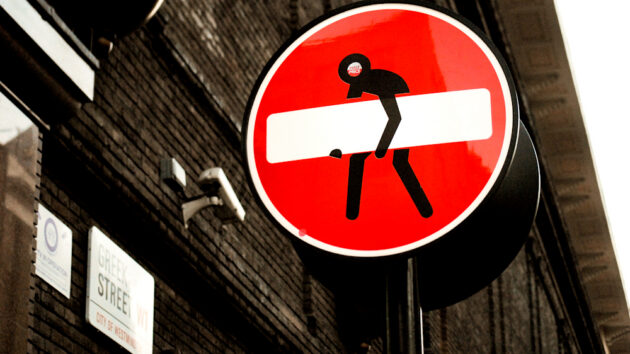
Culture jamming usually works through recognition. A logo is modified, a slogan reversed, a billboard corrected. A familiar brand image is pushed slightly beyond the point where it can continue pretending to be innocent.
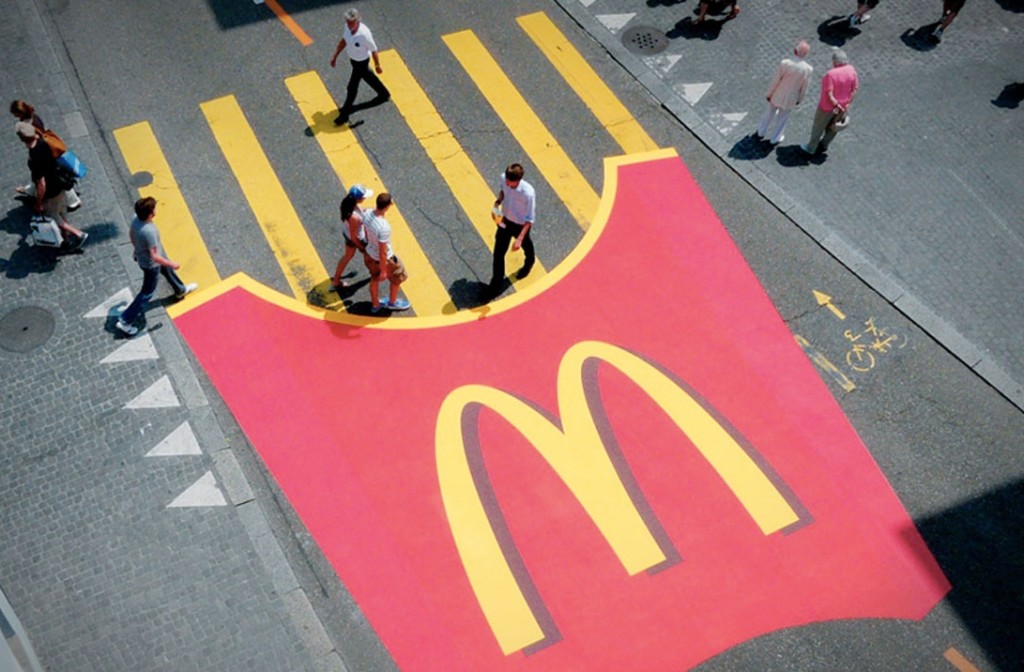
The audience already knows the original. The intervention hijacks the time, money, and cultural familiarity invested in it. It does not need to build a stage of its own. It climbs onto one erected by Coca-Cola, Nike, McDonald’s, or the national government and begins delivering unauthorized dialogue.
The weakness of culture jamming lies in the digestive powers of its target. Consumer culture can convert rebellion into a font, a shoe, a streaming series, or a limited-edition beverage before the rebellion has finished setting up its folding table.
Yesterday’s rebellious visual language becomes tomorrow’s brand identity. The skull acquires a trademark. The détourned slogan becomes a tote bag. “Resistance” appears on a product manufactured under conditions that would make resistance advisable.
Culture jamming still works, but it operates inside a hostile digestive system. The spectacle does not only defend itself against criticism. It eats criticism and asks whether there is any more.
Détournement has a more specific historical and theoretical lineage. Guy Debord and Gil J. Wolman described it as the reuse or rerouting of preexisting elements within a new ensemble, and it became one of the Situationist International’s central methods.
A comic strip receives new dialogue. A political speech is re-edited. A classical painting is placed in a vulgar context. An advertisement is altered until the violence beneath its polished surface becomes visible.
Parody tends to mock an original while leaving its authority largely intact. Détournement attempts to steal that authority, along with its emotional energy and cultural prestige, and put it to other uses. It is intellectual burglary with a social purpose.
The difference between détournement and culture jamming is partly historical. Détournement belongs to a larger revolutionary critique of capitalism, spectacle, and everyday life, while culture jamming often refers more narrowly to interventions in advertising and mass media. In practice, however, the two have long shared tools, personnel, and photocopiers.
Subvertising
Subvertising gives culture jamming a particularly clear target: advertising.
It mimics, modifies, or replaces commercial advertisements in order to attack a product, a company, an industry, or the advertising system itself. The action may involve physically altering a billboard, producing a counterfeit campaign, or inserting unauthorized posters into commercial display infrastructure.

Advertising has already trained people to process images quickly, which makes its formats useful to an intruder. Nobody expects to conduct a philosophical seminar at a bus shelter. The message must arrive before the bus does.
This directness is also a limitation. Subvertising usually keeps the target clearly in view: this company is lying, this product is harmful, this image is manipulative. Such clarity can be politically valuable, though it often leaves the larger communicative structure untouched.
The billboard is corrected. The society organized around billboards remains in place.
Media Pranks
Where subvertising tampers with a message already in circulation, the media prank attacks the machinery that determines what enters circulation at all.
It gives journalists a story, identity, event, or institution plausible enough to be treated as news. This may involve a fake spokesperson, an invented organization, a counterfeit press release, a fabricated expert, or a carefully staged occurrence.
Journalists work under time pressure. They need quotations, images, protagonists, and events with beginnings, middles, and, ideally, a usable headline. The prank manufactures these ingredients in a form the system already knows how to process.
The Yes Men’s impersonation of a Dow Chemical spokesperson on the BBC remains a classic example. Their false announcement accepting responsibility for the Bhopal disaster was broadcast live and widely repeated before being corrected. The episode exposed the vulnerability of media verification, but also the political desire to hear corporate accountability spoken into being.
At its most useful, the media prank becomes a diagnostic device. It reveals which authorities journalists recognize, what they are prepared to believe, what they fail to verify, and what kind of story they want badly enough to help create.
Fooling a newspaper is not automatically a political achievement. Children, public-relations agencies, and April Fools’ Day manage it regularly. The relevant question is what the deception exposes.
Does it reveal an ideological reflex? Does it force a neglected issue into public discussion? Does it embarrass an institution into admitting something true? Or does it merely establish that a stressed junior editor can be tricked before lunch?
Without that analysis, the prank becomes unpaid content production.
Tactical Media
Tactical media shifts attention away from a single symbolic technique and toward temporary infrastructure.
The term emerged in the 1990s, especially around the Next 5 Minutes conferences in Amsterdam, where artists, activists, and theorists gave a name to interventions built from cheap tools, political urgency, and improvised networks. It was less a stable school than a temporary coalition held together by the conviction that media could be repurposed faster than institutions could fully understand what had happened.
The word “tactical” matters. These projects are situational rather than permanent. They appear around a conflict, campaign, protest, crisis, or political opportunity, using whatever medium happens to be available and appropriate.
A fax machine, photocopier, mailing list, mesh network, pirate radio station, or social-media account is politically useful under particular conditions. None is inherently emancipatory.
This distinguishes tactical media from the recurring fantasy that a new platform will automatically democratize society. Every few years, technology produces a fresh machine allegedly destined to liberate humanity. Humanity uses it to argue with strangers, advertise protein powder, and rebuild several older forms of authoritarianism at greater speed.
Tactical media treats technologies as tools rather than prophecies. Its concern is practical: what can this device do here, now, for these people?
Hacktivism
Hacktivism brings political action into direct contact with the methods, culture, and infrastructure of computer hacking.
The term is commonly traced to the Cult of the Dead Cow, which coined it in 1996 as part of a broader hacker politics connecting technical expertise with civil liberties and anti-censorship work. It emerged from hacker ethics, digital free-speech politics, and the recognition that access to infrastructure is itself a political question.
Hacktivism can include website defacement, digital sit-ins, mirror sites, censorship circumvention, information leaks, software development, data liberation, infrastructure disruption, and the creation of privacy or communication tools.
Its strongest forms understand that technical systems are also political systems. Protocols regulate access. Interfaces distribute power. Databases define people. Search systems determine visibility. Algorithms make decisions while pretending to be unusually complicated weather.
Hacktivism intervenes directly in these arrangements.
The overlap with tactical media is substantial, though their emphases differ. Tactical media concerns the use of communication technologies within a particular struggle. Hacktivism carries a stronger interest in systems, access, code, vulnerabilities, and unauthorized modification.
Popular culture prefers a more romantic image: the solitary genius in a black hoodie, typing against tyranny while green symbols descend attractively across the screen.
Actual political hacking usually involves documentation, coordination, maintenance, legal risk, security procedures, and lengthy discussions about whether somebody has accidentally uploaded everyone’s IP addresses.
Artivism
Artivism is the broadest and sometimes vaguest term in this collection. It describes the overlap between artistic practice and political activism: protest theatre, political performance, interventionist sculpture, campaign graphics, participatory installations, activist filmmaking, public actions, and many other hybrids.
The term becomes useful when art participates in a political struggle rather than simply representing one. The work may mobilize people, raise money, produce visibility, support a campaign, occupy space, or create tools for a community.

Yet the combination also contains a genuine tension.
Activism usually has an external goal: stop the demolition, change the law, defend the community, expose the abuse. Art often maintains a greater tolerance for ambiguity, contradiction, failure, and meanings that refuse to stand in a straight line.
Activists may need a clear message. Artists occasionally regard a clear message as a suspiciously well-dressed corpse.
The alliance therefore requires negotiation. A work does not become politically effective because its description includes the words “resistance,” “liminality,” and “late capitalism.” An activist campaign does not become artistically interesting because somebody brought a projector.
Institutional Critique
Institutional critique examines the structures that produce and legitimize culture: museums, galleries, universities, archives, foundations, collections, funding bodies, and markets.
It grew from postwar art’s increasing suspicion that the institution was never a neutral container. Figures such as Hans Haacke and Andrea Fraser made the conditions of display part of the artwork’s argument.
Instead of treating an artwork as an autonomous object, institutional critique asks who selected it, who financed it, who owns it, who cleans the room, whose history is being preserved, and whose remains inconveniently absent.
Its classic arena is the art institution, though the logic extends further. Institutions habitually present their decisions as natural or inevitable. Institutional critique exposes the architecture, money, labour, and ideology beneath that appearance.
Its recurring danger is absorption. A museum may host a devastating critique of museum power, print an elegant catalogue about it, sell related merchandise, and congratulate itself on its openness.
The institution survives by exhibiting the weapon used against it.
Absorption is not always complete, however. Institutional critique can expose hidden relationships, create material changes, and produce vocabularies that later movements use more aggressively. Being invited inside does not necessarily neutralize criticism. Sometimes it gives criticism access to the electrical system.
Urban Intervention
Urban intervention treats the city as a medium.
Street signs, traffic systems, monuments, vacant lots, surveillance infrastructure, benches, barriers, and architectural leftovers become materials for artistic or political action.
Some interventions are symbolic: altered signs, unofficial monuments, absurd wayfinding systems. Others are functional: unauthorized seating, community infrastructure, reclaimed space, hidden gardens, or tools that make hostile architecture usable again.
Such actions reveal that public space is already designed behaviour.
A bench tells you how to sit. A barrier tells you where not to walk. A camera establishes who is entitled to watch whom. A monument announces which dead person continues to occupy valuable real estate.
The urban intervention edits these instructions, occasionally with a screwdriver.
Context Hacking
Context hacking shares techniques with all these approaches, but shifts the emphasis from the object being altered to the arrangement that gives the object meaning.
The term was coined in the early 2000s by Johannes Grenzfurthner of the art collective monochrom. Drawing on his own practice, Grenzfurthner presented an early concise formulation of the concept at eTech in 2008 and later developed its theoretical framework with Schneider and Friesinger in 2013. Monochrom’s combination of zines, pranks, theory, performance, and media intervention offers a contemporary bridge between many of the traditions discussed here.
Context hacking treats a social, technical, artistic, or institutional situation as a system. That system has rules, interfaces, permissions, assumptions, and expected forms of behaviour. It has something resembling source code, even when the code consists of etiquette, architecture, professional habit, administrative procedure, cultural memory, or simple embarrassment.
To hack a context is to understand these rules well enough to use them improperly.
The intervention may employ signs, media, software, performance, objects, organizations, or public space. Context hacking is not attached to a single medium. The medium is selected according to the vulnerability.
Culture jamming usually begins with an existing cultural message. Hacktivism begins with a technical system. Institutional critique begins with an institution, and urban intervention with physical space. Context hacking begins with the larger arrangement that makes an action intelligible in the first place.
A press conference is a context. So is an academic conference, a funeral, a technology trade show, a border crossing, a television interview, an art fair, a corporate retreat, or a village festival devoted to asparagus.
Each contains expectations. Certain people are authorized to speak. Certain objects are allowed to appear. Certain questions count as sensible. Certain tones are taken as evidence of competence. A successful context hack identifies these expectations and introduces an element that is simultaneously wrong and disturbingly compatible.
This is why over-identification is such a powerful technique. Rather than opposing an ideology, the intervention performs it with excessive sincerity.
It does not announce that the system is absurd. It announces, with apparent enthusiasm, the next logical stage of the system.
The audience is left to determine whether it has witnessed parody, policy, or an unusually honest press release.
Context hacking therefore exceeds the production of critical content. It does not simply send an alternative message through an existing channel. It interferes with the channel, the sender, the receiver, and the reason everyone believed they were gathered in the room.
A Family of Bad Manners
These practices are better understood as overlapping traditions than as competing brands. A single intervention may deceive journalists, manipulate signs of authority, use temporary infrastructure, combine aesthetic and political goals, and exploit the rules of an entire situation at the same time.
Nothing is gained by arresting the action at a conceptual border crossing and demanding to see its theoretical passport.
The distinctions still matter because they direct attention toward different vulnerabilities. Culture jamming concentrates on dominant images and their reversal. Guerrilla communication looks at the production of meaning and authority. Tactical media concerns the tools available within a specific struggle, while hacktivism enters more directly into technical systems and questions of access.
Institutional critique follows the structures that organize visibility, legitimacy, and value. Urban intervention examines the way physical environments regulate behaviour. Artivism concerns the difficult collaboration between aesthetic practice and political action. Context hacking draws these levels together by asking which unspoken rules hold a situation in place, and what happens when an intruder understands those rules better than the people officially in charge.
All of them reject the idea that communication is a neutral transfer of information. Communication is organized and staged. It comes with furniture, passwords, costumes, protocols, permissions, and property relations.
Political intervention may therefore require more than another statement. Sometimes the statement is not the vulnerable part.
Sometimes you have to tamper with the room.
Benno Hilgers is a pop-culture theorist and researcher associated with DeC/VIE. He currently lives in a shack outside Vienna. The shack contains a well-sorted collection of Blu-rays and art-history books, and there is a pool right outside, just to be precise.
Bildquellen
- 6912703968_fc6c20cbc5_o: · · · — — — · · ·, Culture Jamming, CC BY-NC 2.0